AI Agent Security: How to Secure Autonomous AI Systems Before They Reach Production
As AI agents begin acting with real permissions, secure design, approval gates, and testing become essential before deployment.
AI Agent Security: How to Secure Autonomous AI Systems Before They Reach Production
AI agents are moving from experiments to real workflows. They can do more than answer questions. They can access tools, trigger actions, use credentials, and interact with multiple systems.
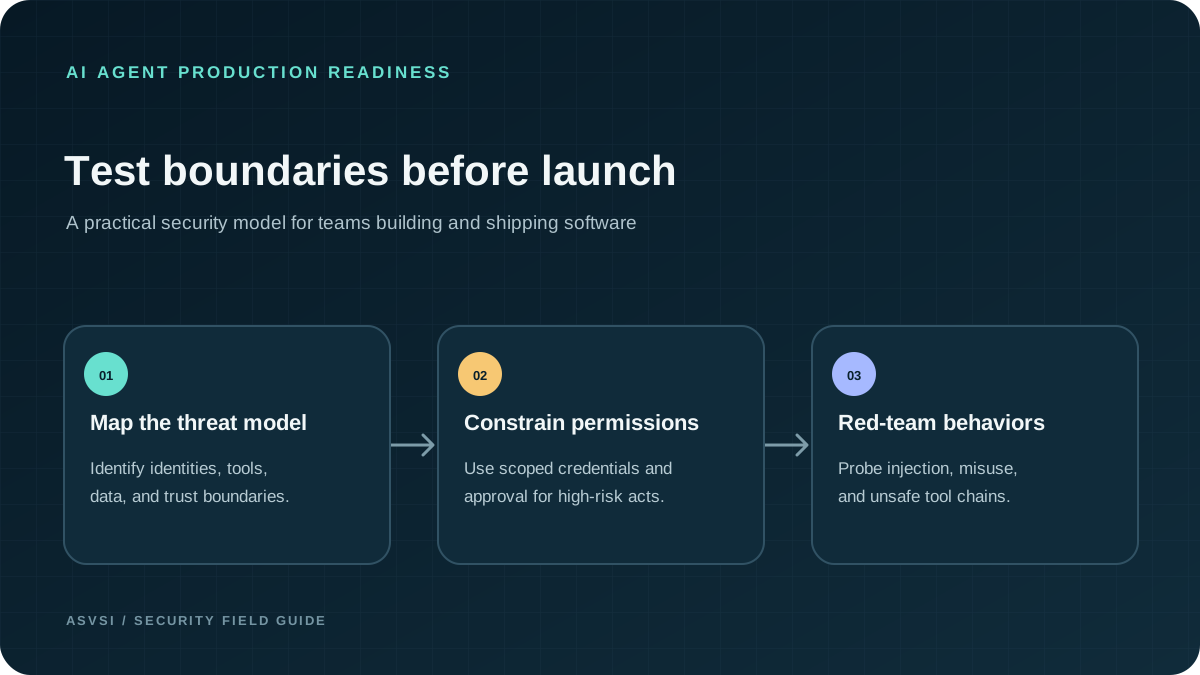
That is why the question is no longer “can AI do the task?” It is “what happens when the agent is allowed to act?”
Before a production deployment, security teams need a clear answer to that question.
Why autonomous AI systems need a different security model
Traditional software usually has visible boundaries:
- users interact with an app
- the app calls a backend
- the backend accesses data or services
- permissions are controlled by explicit server logic
AI agents often add another layer:
- the model decides what action to take
- tools are invoked based on the model’s reasoning
- inputs can come from users, memory, documents, APIs, or other systems
- actions can be broader and more dynamic than fixed application logic
This makes the risk model broader. It is not only about the model answering incorrectly. It is about the system taking the wrong action when given the wrong context.
The biggest production risks
Goal hijacking
A model may be steered away from the intended objective by misleading input or external instructions. That can result in actions that are technically possible but wrong for the real task.
Tool misuse
If an agent has access to tools, a malicious or manipulated prompt can cause it to use those tools incorrectly, too often, or with the wrong set of parameters.
Identity and privilege abuse
If the agent uses long-lived credentials or broad identity scopes, a compromised or confused agent can access more than intended. This is one of the highest-risk problems in enterprise AI adoption.
Memory poisoning
When an agent stores context or maintains memory across sessions, untrusted information can influence future decisions. This leads to a chain of cumulative risk that is hard to diagnose later.
Rogue or untrusted agent behavior
Multi-agent systems create new attack paths when one agent trusts another without the same verification and boundaries that a human would apply.
Supply-chain vulnerabilities
The agent may rely on plugins, dependencies, or packages that are outdated or compromised. This is especially relevant when tool ecosystems expand quickly.
What good AI-agent security looks like
A secure autonomous system should have a clear security plan for:
- user trust boundaries
- tool access boundaries
- identity and credentials
- approval points for sensitive tasks
- observability and logging
- failure handling and rollback paths
- adversarial simulation and red-team testing
The model should not be treated as a source of safety. It is one part of a larger system that has security controls built around it.
Practical controls to implement before production
1. Use least-privilege credentials
Agents should use short-lived credentials, scoped permissions, and narrowly defined access windows. Broad service accounts are a major operational risk.
2. Gate high-risk actions
Anything involving financial decisions, sensitive data, external write actions, or administrative operations should be gated behind a deliberate approval step.
3. Validate tool input and output
Tool parameters should be validated, and tool responses should be checked for unexpected content or unsafe structure before they influence decisions.
4. Separate planning from execution
A common pattern is to have the model propose a plan and then let a controlled policy layer decide whether the action should proceed.
5. Build audit trails
Security and engineering teams need to see which actions the agent attempted, which tools it used, and what data it accessed. Without that, incident response is almost impossible.
6. Design for adversarial prompts
Security testing should include direct prompt injection attempts, hidden instructions in documents or URLs, deceptive user input, and malicious third-party content.
The AI-agent security review checklist
Before shipping, ask these questions:
- What permissions does the agent actually need?
- Which tools are available, and what is each tool allowed to do?
- Are credentials short-lived and scoped?
- Are there approval gates for sensitive workflows?
- Is memory or context handling isolated and validated?
- How are prompts from untrusted sources handled?
- What happens if a tool fails or returns unexpected data?
- Can the system be audited after a potentially harmful action?
If the answer is unclear, the agent is not ready for production.
AI red teaming is not optional
Red-teaming is one of the clearest ways to identify problems before release. This should include:
- prompt injection testing
- tool misuse simulation
- privilege escalation attempts
- multi-step attack planning
- memory poisoning testing
- analysis of agent chaining and trust boundaries
This is where a lot of real-world AI security problems appear: not in the obvious model output, but in how the system behaves under adversarial conditions.
Final takeaway
AI agents are powerful, but they are not safe by default. They require the same kind of critical review as any privileged software system, and in many cases more.
The strongest production strategy is not to trust the agent’s autonomy blindly. It is to design a system where security boundaries, credentials, tool access, and human oversight all remain explicit and enforceable.
That is a strong commercial positioning for ASVSI: helping teams deploy AI systems that can act, but do so under control.