AI Agent Security: The Complete Guide to Securing Autonomous AI Systems
Autonomous AI agents introduce new security risks around permissions, tool access, prompt injection, and execution boundaries.
AI Agent Security: The Complete Guide to Securing Autonomous AI Systems
AI agents are becoming more capable. They can reason, call external tools, access APIs, interact with systems, and perform tasks with limited supervision.
That creates a very different security challenge from standard software applications. A traditional app has a relatively clear boundary. An AI agent may have many tools, external permissions, and decision paths shaped by dynamic input.
The result is a broader and more complex attack surface.
What makes AI agents different?
An AI agent is not just a chatbot. It can operate with:
- scoped tool access
- credentials or API keys
- memory or session state
- external system integrations
- autonomous action loops
- multi-step planning and execution
This turns the application into something more like a security-sensitive workflow engine.
The risk is not only that the model can be tricked. It is that the system can be manipulated into taking actions it should not take, leaking data it should not expose, or calling tools outside policy boundaries.
The main AI agent security risks
Prompt injection
A model may receive untrusted input from a user, a document, a website, or another agent. If that input influences tool usage or decision-making, prompt injection becomes a major risk.
In practice, that can lead to:
- unauthorized actions
- misleading tool execution
- altered reasoning or hidden instructions
- leakage of protected system context
Excessive permissions
Many AI agent failures come from over-privileged access. If an agent has broad database, API, or admin permissions, a prompt or tool-generated mistake can become a real security incident.
Every tool should be least-privilege by default.
Tool and API abuse
Agents often operate by invoking tools or APIs. If those tools are not carefully governed, a malicious or manipulated agent can:
- send data to the wrong endpoint
- manipulate financial workflows
- trigger side effects beyond the intended scope
- execute unsafe commands or actions
The security boundary is no longer just the model. It is the entire execution chain.
Credential exposure
An autonomous system that stores or exposes credentials, session tokens, or service keys is at risk. AI agent failures can leak these values through logs, prompts, memory, or uncontrolled tool output.
Data leakage
Agents often interact with large volumes of information. If they can access sensitive internal data, they may leak it through external tools, poorly constrained outputs, or indirect prompt flows.
This is especially important in enterprise environments where agents can access emails, documents, project files, or customer records.
Agent-to-agent risk
When one AI agent interacts with another, the security model becomes more complex. Agents may trust each other too much, share sensitive context, or perform chained actions without a strong policy boundary.
The security design principles for AI agents
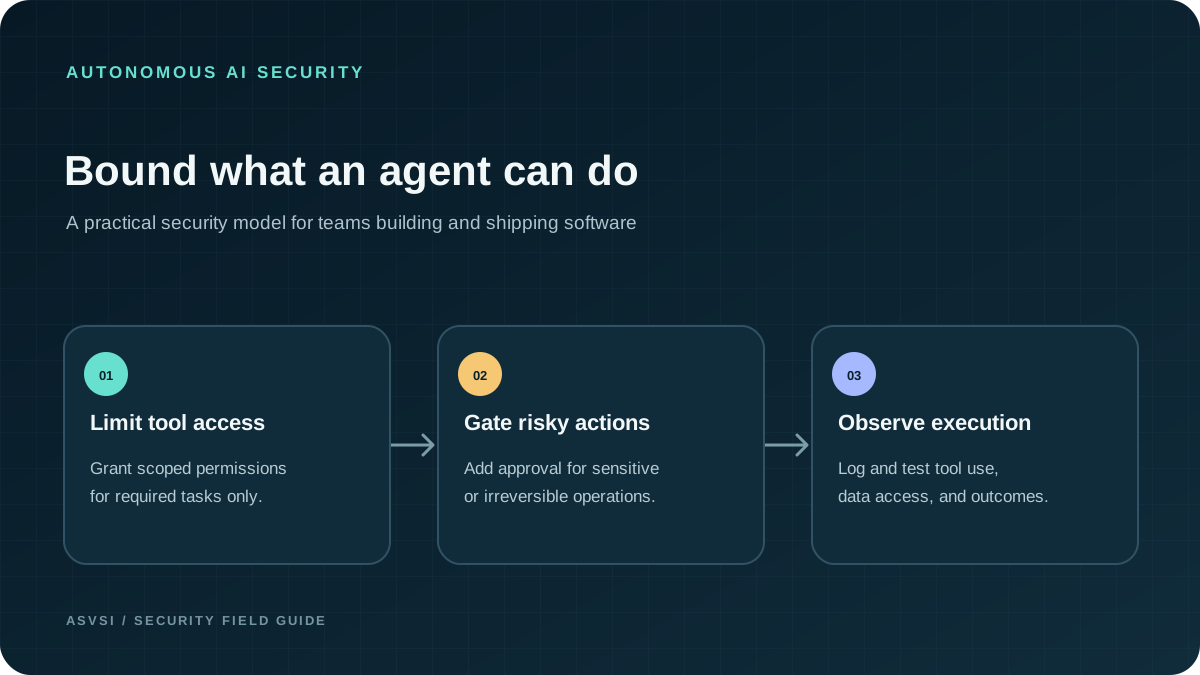
1. Minimize permissions
An agent should only access the systems it truly needs. If a workflow requires read-only access, do not grant write access. If it needs a short-lived session token, do not use long-term credentials.
2. Separate planning from execution
A useful pattern is to separate reasoning from action. The model can propose a plan, but a more controlled system should validate and approve the actual execution path.
3. Keep a human approval step for sensitive actions
Not every task should be automatically executed. Financial actions, privileged API calls, destructive operations, and anything involving customer data should generally require explicit approval or a reduced-risk control flow.
4. Validate tool outputs
Even when an agent calls a trusted tool, the output should be validated. Tool responses can be manipulated, partial, or misleading.
5. Treat prompts as untrusted input
Any information that comes from the outside should be treated as potentially adversarial. The system should not assume that a prompt, document, webpage, or user message is safe.
6. Keep execution logs and audit trails
Security teams need to know what an agent did, which tools it used, what data it accessed, and what decisions it made. Without observability, AI-agent incidents are difficult to investigate.
7. Test for adversarial behavior
AI agent security needs red-team testing. This includes testing prompt injection attempts, tool misuse, unsafe API calls, and chained multi-step scenarios.
Recommended architecture patterns
A secure autonomous agent system usually includes:
- policy gatekeeping before execution
- input filtering and validation
- scoped credentials and ephemeral tokens
- approval steps for privileged actions
- explicit tool allowlists
- output validation and sanitization
- user-visible audit logs
- system monitoring and anomaly detection
This is far more robust than simply trusting the model to behave responsibly.
Security testing for AI agents
Teams should test for:
- malicious user instructions
- prompt injection through documents or URLs
- tools that trigger unintended side effects
- leaks through model responses
- credential misuse
- session hijacking or token leakage
- unsafe agent chaining
- excessive tool action under ambiguous prompts
Formal testing should simulate both normal use and adversarial use.
The AI agent security checklist
Before production, teams should check:
- Are permissions limited and role-based?
- Are sensitive actions gated by approval?
- Are session credentials short-lived?
- Is tool usage restricted to an allowlist?
- Are prompts and external content treated as untrusted?
- Are outputs validated before execution?
- Are actions logged and auditable?
- Is there a response plan for malicious prompts or tool misuse?
If these questions are not clearly answered, the system is not ready for broader autonomous use.
Final takeaway
AI agent security is not just about model safety. It is about system security.
The most important lesson is simple: autonomous systems need stronger boundaries, better permission controls, and more explicit governance than traditional software.
As AI agents become more integrated into business operations, security teams need to treat them like any other privileged system: with least privilege, strong observability, and a clear approval model for risky actions.
This is a strong AI security theme for ASVSI because it connects directly to the reality that AI is becoming operationally active, not just informational.