AI-Generated Code Security: How to Detect Vulnerabilities Before Production
AI-generated code can accelerate development, but it still needs strong validation to catch insecure logic, dependency issues, and unsafe defaults before launch.
AI-Generated Code Security: How to Detect Vulnerabilities Before Production
AI systems can generate code extremely fast. That is a productivity win, but it also means large amounts of code can reach a team in a very short time without the same level of human review that slower, manual development often gets.
The result is a familiar risk: code that looks correct and compiles cleanly, but still contains vulnerabilities that are easy to miss if the team relies on generation alone.
Why AI-generated code creates unique security risk
The main problem is not that AI writes code incorrectly 100% of the time. It is that the model can generate code that is:
- syntactically valid
- superficially functional
- structurally plausible
- but still insecure in deployment
This can happen because the model lacks context around:
- business logic requirements
- trust boundaries
- authorization expectations
- secure configuration defaults
- real-world attack paths
- dependency hygiene and supply-chain risk
A generated file may pass basic checks and still violate secure design principles.
Common vulnerability patterns in AI-generated code
Some of the most common issues include:
- missing authentication checks
- insecure authorization logic
- weak validation of user input
- unsafe query construction
- hardcoded secrets or weak secret handling
- vulnerable library choices
- improper error handling
- insecure file or API access patterns
- unsafe cryptographic defaults
- forgotten privilege boundaries in generated components
These are not “AI-specific” in the sense of being impossible in human-written code. But AI-generated code often reaches review and testing at scale, which increases the chance of mistakes being missed.
Security review should start before the code is trusted
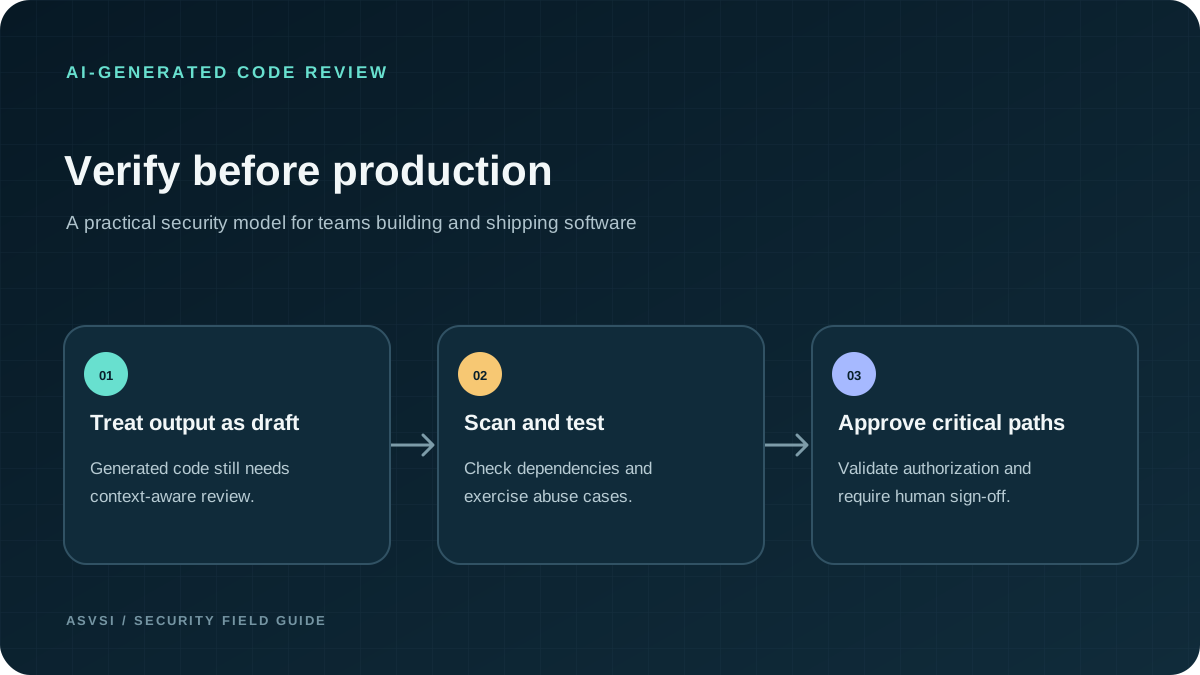
The safest approach is to treat generated code as draft output until it has been reviewed under security criteria.
A practical workflow looks like this:
- Define the security requirements for the feature
- Ask the model to generate code under those constraints
- Run automated security scans and dependency checks
- Review the generated code for risky patterns
- Validate access control, auth, and API boundaries
- Test behavior under attack scenarios
- Require human sign-off before production release
Tools matter, but they are not enough
Static analysis, SAST, dependency scanning, and regular test suites are useful. They help catch common issues quickly, especially when teams are working with large AI-generated code volumes.
But AI-generated code still needs human review in the high-risk areas:
- authentication and authorization
- data handling and serialization
- secrets management
- network and API boundaries
- business critical user workflows
- configuration and deployment logic
A scanner can help, but it does not understand the intent of the application as well as a human reviewer looking at the actual trust model.
The security questions teams should ask
Before approving code, teams should ask:
- Does this code enforce the right authentication and authorization model?
- Are there any secrets or credentials embedded or exposed?
- Are input validations and outputs safe?
- Does the code trust external data too much?
- Are dependencies known, verified, and maintained?
- Are security-sensitive paths reviewed manually?
- Has the code been tested under normal and adversarial conditions?
If the answer is not clearly yes, the code should not be treated as ready for production.
A real-world AI security workflow
The strongest teams use AI as an accelerator but keep the review discipline intact.
That means:
- AI generates code quickly
- engineering validates logic and security intent
- tools scan the code and dependencies
- the team reviews critical paths manually
- production readiness depends on evidence, not assumptions
This is how teams protect velocity without lowering standards.
Final takeaway
AI-generated code is not automatically insecure, but it is not automatically safe either.
The safest path is to build a workflow where AI speeds up creation while verification, testing, and human security review remain mandatory.
For ASVSI, this is a strong article theme because it speaks to a real business need: how to use AI responsibly without shipping insecure software into production.