How AI Coding Agents Are Changing Software Security in 2026
AI coding agents are accelerating development, but they also change the risk model for security reviews, testing, and production validation.
How AI Coding Agents Are Changing Software Security in 2026
AI coding agents are no longer a novelty. They can inspect repositories, propose patches, write new code, run tests, and perform repetitive development work at a speed that would have been unthinkable just a few years ago.
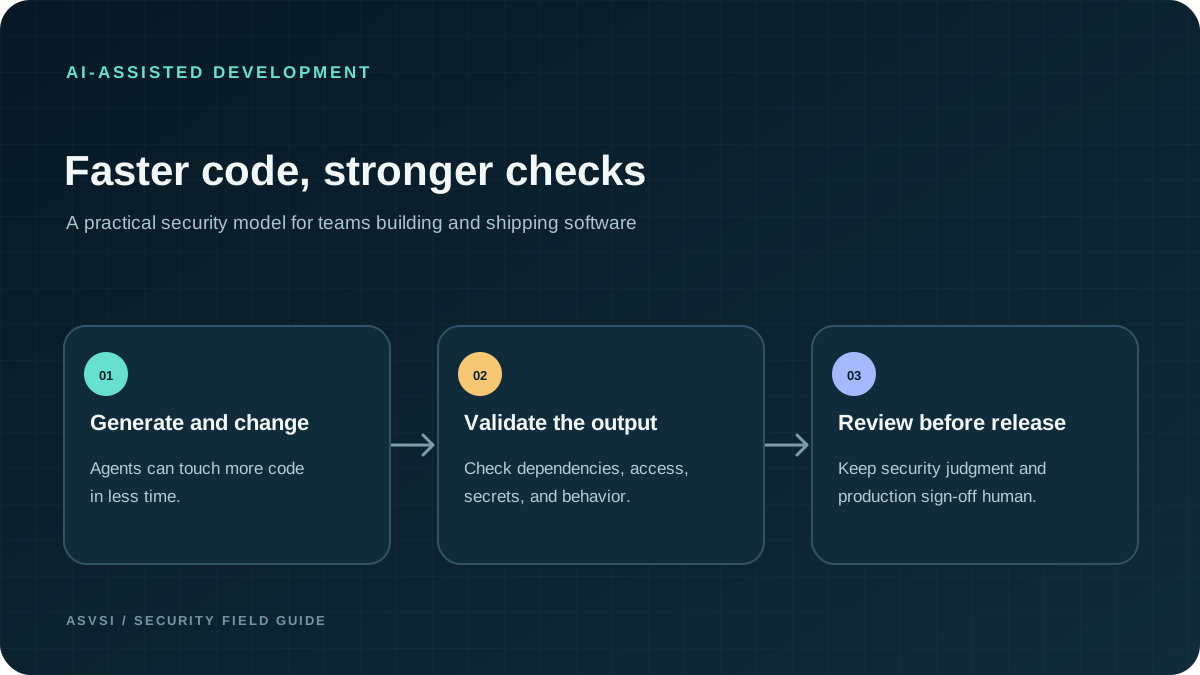
That creates a major question for engineering teams: if AI can generate large parts of an application, who is responsible for security validation?
The answer is not “less security.” It is a new security workflow that combines AI productivity with stronger human oversight.
Why this matters now
AI systems are increasingly being used to:
- generate application code
- modify existing modules
- build scripts and configuration
- integrate third-party tools and dependencies
- produce infrastructure definitions
- help with code reviews and test generation
This changes the software development process in a way that directly affects risk.
A team can now ship code faster, but it may also ship code that contains hidden issues: insecure defaults, vulnerable dependencies, unsafe authentication flows, or logic mistakes that are harder to catch because the code was generated rather than written line by line by a human engineer.
The new risk model
AI coding agents do not eliminate traditional software risk. They change where risk enters the lifecycle.
Common AI-related security concerns include:
- insecure code generated from incomplete prompts
- hallucinated packages or dependencies
- weak secrets handling in generated config files
- missing authorization checks
- insecure API patterns copied into production code
- over-permissioned tool usage in autonomous workflows
- insufficient testing of generated logic
- false confidence from “working code” that is not secure
In other words, the problem is not simply that AI writes code. The real problem is that AI can generate large amounts of code quickly, while humans may not have the same level of review depth or context before it reaches production.
AI-generated code is not automatically secure
One of the biggest mistakes teams make is treating AI-generated output as if it were reviewed and validated by default.
A generated module can look clean and syntactically correct while still having:
- broken access control
- poor validation
- unsafe deserialization or parsing
- insecure file handling
- misconfigured secrets management
- weak cryptographic choices
- business logic flaws that only appear under real workloads
The fact that the code was generated by an AI system does not make it safe. It simply makes the need for review, validation, and testing more important.
AI coding agents change the role of security testing
Security teams and developers need to adapt the review process.
This means more emphasis on:
- running static analysis on generated code
- validating dependencies before deployment
- checking whether generated code introduces insecure defaults
- reviewing access control logic manually
- verifying secrets handling and environment configuration
- testing edge cases and abuse paths
- ensuring generated code matches security policies
AI can speed up the creation of code, but it does not replace the need for a structured security process.
The human review problem
AI tools are especially risky when a team assumes that because the code is “clean” or the tests pass, it is safe.
This is a core issue in 2026:
AI can accelerate delivery, but speed without verification creates a larger chance of production mistakes.
Human review still matters because the most dangerous issues are often not syntax errors. They are design flaws, authorization mistakes, and operational assumptions that are hard for a generator to understand without broader context.
A stronger AI-secure development workflow
A better process looks like this:
- Define security requirements before generation
- Use AI to accelerate code generation, not to replace design
- Validate dependencies and tool outputs
- Run static analysis and linting
- Review security-critical paths manually
- Test normal and malicious conditions
- Validate secrets, auth, and permissions
- Perform security review before deployment
This gives teams AI leverage without removing accountability.
Where AI can actually help security
AI is not only a risk. It can also improve security operations.
Useful applications include:
- summarizing vulnerability reports
- identifying risky patterns in large codebases
- generating test cases for known attack paths
- reviewing code changes for insecure logic
- surfacing missing validation or auth checks
- helping engineers reason through a large review surface
The key is not to trust AI blindly. It is to use AI as a force multiplier for analysis, not as a substitute for judgment.
What this means for teams
Engineering leaders should treat AI-generated code as a change in workflow, not a change in standards.
Security requirements remain the same:
- validate access control
- limit privileges
- protect secrets
- keep trust boundaries clear
- reduce unnecessary attack surface
- test before release
- maintain human accountability
AI can produce code at scale. Security still has to decide whether that code is acceptable to run in production.
Final takeaway
AI coding agents are changing software security by changing the pace of development and the distribution of review work.
The opportunity is huge. The risk is also real.
The safest companies in 2026 will not reject AI. They will build a disciplined process where AI speeds up development while security and engineering review remain firm guardrails.
This is exactly the kind of strategic security position ASVSI can speak to: AI accelerates the code pipeline, but secure delivery still depends on strong validation, risk assessment, and human judgment.