How Long Does a Smart Contract Audit Take?
Learn the factors that influence smart contract audit timelines, from code complexity to protocol dependencies and remediation rounds.
How Long Does a Smart Contract Audit Take?
There is no single fixed timeframe for a smart contract audit. The duration depends on the size of the codebase, the complexity of the mechanisms, and how ready the project is for review.
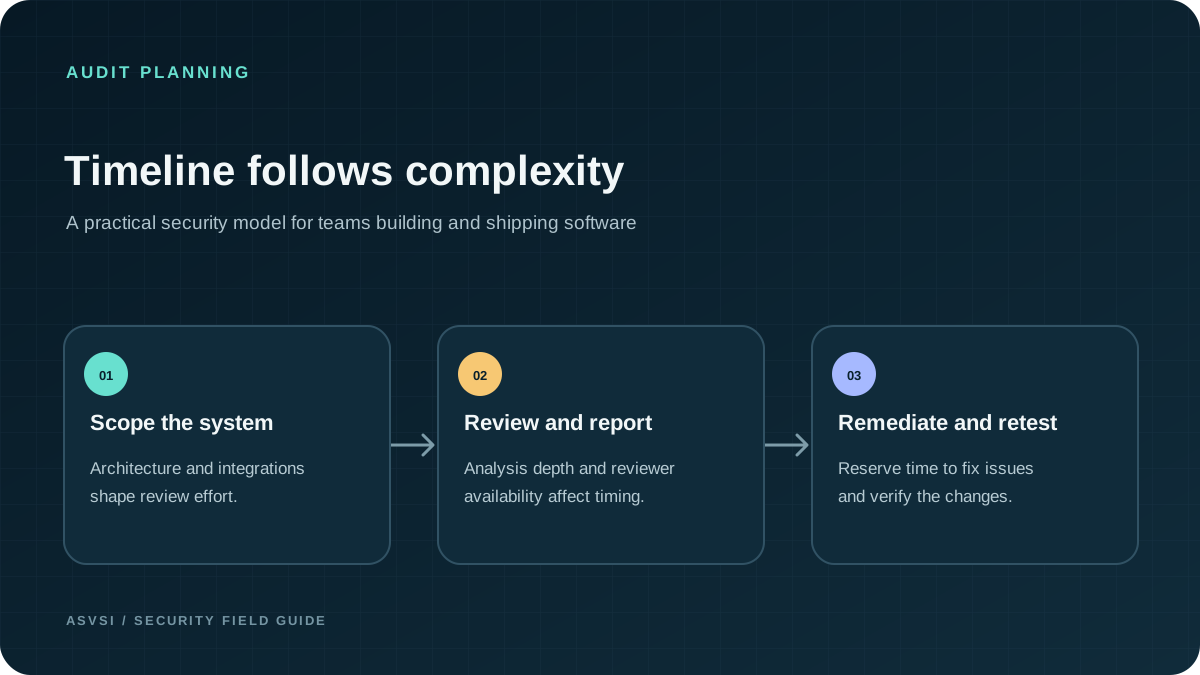
For simple contracts, an audit may take a few days to a couple of weeks. For large or complex protocols, it can take several weeks or longer.
The real drivers of audit duration
1. Contract complexity
A single token or a basic NFT contract is usually faster to review than an AMM, bridge, lending protocol, or multi-contract system with governance and upgrade logic.
2. Architecture and dependencies
A contract that interacts with external protocols, oracles, governance modules, treasury controls, and role-based logic requires more review time than a self-contained system.
3. Documentation quality
If the team provides architecture notes, invariant explanations, and deployment details, reviewers can move faster. If the project is under-documented, the audit often takes longer because the team must reconstruct intent.
4. Test coverage
Good tests can speed the review by clarifying expected behaviour. The more uncertain the protocol behavior is, the slower the review will be.
5. Remediation cycles
A review may uncover issues that need to be fixed, retested, and rechecked. This often adds time, especially if findings are high-impact or require redesign.
6. Auditor availability
Even a well-prepared project will experience a timeline shift if the audit firm is busy or if there are multiple review rounds.
Typical time ranges
| Project type | Typical audit duration | | --- | --- | | ERC-20 or simple NFT contract | 3–10 days | | Small protocol or marketplace | 1–3 weeks | | Staking, vault, or reward system | 2–4 weeks | | DEX, lending, or multi-contract DeFi | 3–6+ weeks | | Bridge or highly complex protocol | 4–8+ weeks |
These ranges are rough and depend on the review scope, the team’s preparation, and the number of findings that require deep follow-up.
Code size is not the whole story
A larger codebase does not always mean a longer audit than a smaller one. A small but highly complex and economically sensitive protocol can take longer than a larger but simpler contract.
The key factors are:
- trust assumptions
- protocol interactions
- upgrade paths
- governance risk
- token behavior assumptions
- economic edge cases
What slows a review down
The most common reasons an audit takes longer than expected are:
- unclear contract intent
- missing architecture notes
- hidden privilege or initialization logic
- complex upgrade paths
- weak or incomplete tests
- many external dependencies
- repeated redesign after findings
How to make the audit faster
Teams can reduce review time by:
- preparing a clean code branch and release tag
- documenting invariants and assumptions
- providing reproducible build instructions
- sharing test results and deployment notes
- limiting scope clearly
- fixing obvious issues before the review begins
This allows the auditor to focus on risk instead of reconstructing the system.
Practical takeaway
A smart contract audit is not a straight line from start to finish. It is a review process that depends on protocol complexity, code quality, and the team’s readiness.
For most serious projects, the timeline should be planned early, especially if the team wants to launch publicly or handle treasury funds.
If you are preparing for launch, it is wise to budget time not only for the initial review but also for remediation and revalidation. That is often the difference between a smooth launch and an avoidable security surprise.