How to Build Secure Software in the Age of AI-Generated Code
AI can accelerate development, but teams still need secure design, strong validation, and human review to ship safe software.
How to Build Secure Software in the Age of AI-Generated Code
AI-generated code is changing how software gets built. It speeds up implementation, helps teams prototype more quickly, and reduces repetitive work.
But it also raises an important security question: if AI writes code, who is responsible for making sure that code is safe?
The answer is still the engineering team. AI can accelerate creation, but it cannot replace secure design, validation, and review.
The core problem
AI tools can produce code that looks polished and functional while still exposing real weaknesses.
That may include:
- insecure authentication patterns
- weak authorization checks
- dangerous use of third-party libraries
- secrets exposed in config or environment files
- SQL injection or unsafe query construction
- XSS vulnerabilities from untrusted rendering
- broken validation and sanitization
- missing error handling or security boundaries
This means the key risk is not “AI wrote the code.” The key risk is “AI wrote code without the same guardrails that a secure software team would use.”
Why security still matters more in AI-assisted development
AI can increase the number of moving parts in a project. It can generate more code faster, create more dependencies, and introduce more gaps between intent and validation.
That increases the importance of:
- clear security requirements
- effective design review
- static analysis and dependency scanning
- automated testing
- secure infrastructure configuration
- human validation of security-critical features
A team that uses AI without a security process will often move faster and fail more loudly later.
The secure SDLC in an AI-driven environment
A secure software lifecycle still needs the same basic controls.
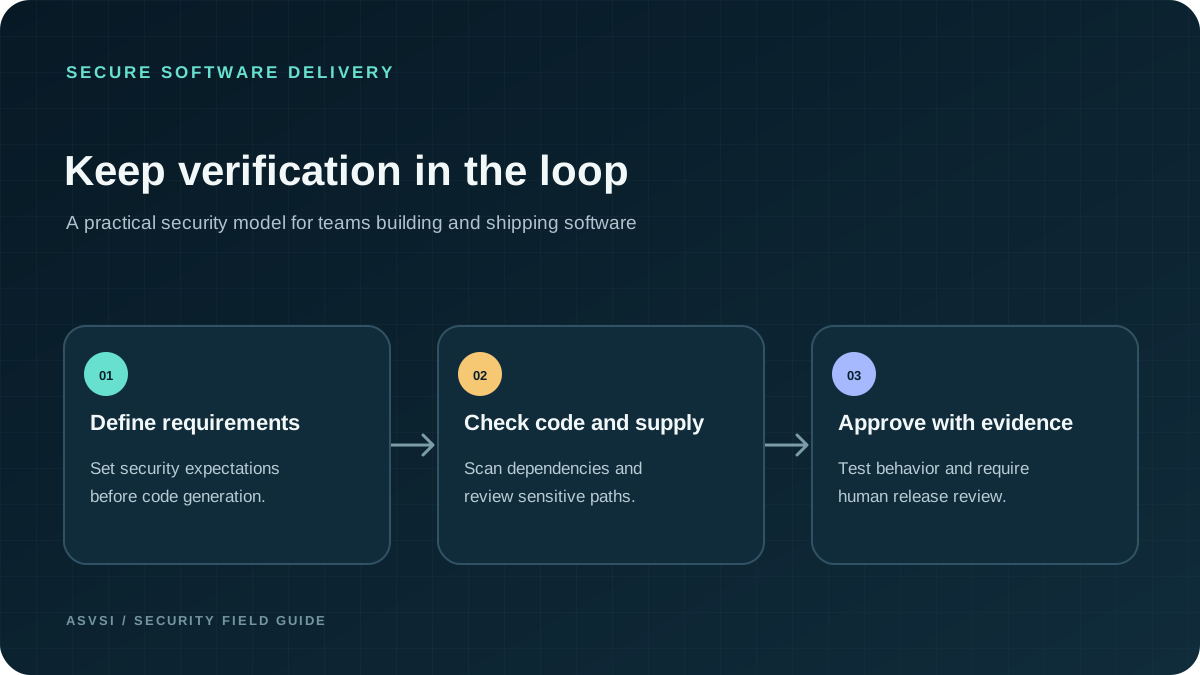
1. Define security requirements before coding
Teams should know what needs protection before they ask an AI system to generate code. That includes:
- authentication model
- authorization rules
- data classification
- validation and sanitization expectations
- secrets handling
- third-party integration constraints
If the threat model is not defined, the AI cannot reliably optimize for safety.
2. Use AI for speed, not for replacing reasoning
AI should assist product and engineering teams, not serve as a replacement for technical judgment.
It can help with:
- code scaffolding
- documentation
- test generation
- refactoring
- risk spotting in large codebases
But security-critical decisions still need human ownership.
3. Validate dependencies and generated modules
AI tools may generate code that depends on libraries or packages that are outdated, malicious, or poorly maintained. Teams should do dependency checks, vulnerability scans, and package verification before rollout.
4. Check for common vulnerability patterns
AI-generated code can accidentally copy insecure patterns from public examples or generate inputs that are not properly validated.
Security review should prioritize:
- injection risks
- insecure auth flows
- broken access control
- unsafe data serialization
- path traversal and file exposure
- unsafe crypto choices
- CORS or API security problems
5. Test the real behavior, not just the generated output
A model may produce code that passes a superficial compile step but fails under malicious input or realistic misuse conditions.
Teams should validate:
- authentication and authorization
- edge-case input handling
- boundary condition tests
- regression tests for security-sensitive features
- abuse-case simulations
- deployment-time configuration validation
Security controls that still matter
Even with AI generation, teams should maintain strong secure development practices:
- SAST and dependency scanning
- DAST where appropriate
- code review for critical paths
- secret management and environment protection
- role-based access controls
- output validation and sanitization
- secure incident response processes
A secure software pipeline is not a moving target just because AI is helping write the code.
The role of human review
This is the most important point: AI can help find patterns, but it cannot replace the judgment required to understand business logic, trust boundaries, and real-world exploitability.
Human review is still necessary for:
- security architecture
- business logic validation
- access control review
- production risk assessment
- incident response planning
- final approval before release
A practical AI-safe engineering workflow
A team can build securely with AI by following this pattern:
- Define the security model
- Ask AI to generate code against those constraints
- Review generated code for risky patterns
- Run security tools and tests
- Validate permissions and secrets handling
- Verify code behavior under attack scenarios
- Require human sign-off on production release
This is much safer than treating AI as a “fully capable autonomous engineer.”
Final takeaway
AI-generated code changes the speed of software development, but not the fundamentals of secure engineering.
The safe approach is simple: use AI to accelerate the process, but maintain human responsibility for security, policy, and validation.
That is how teams can benefit from AI without lowering their standards. And it is exactly the kind of capability ASVSI can position itself around: helping teams ship software faster without exposing themselves to preventable security problems.