How to Choose a Smart Contract Audit Company: 15 Questions to Ask Before Hiring One
Use this checklist to evaluate a smart contract audit firm before committing budget, time, and launch confidence.
How to Choose a Smart Contract Audit Company: 15 Questions to Ask Before Hiring One
Choosing a smart contract audit company is not just a procurement decision. It is a risk decision.
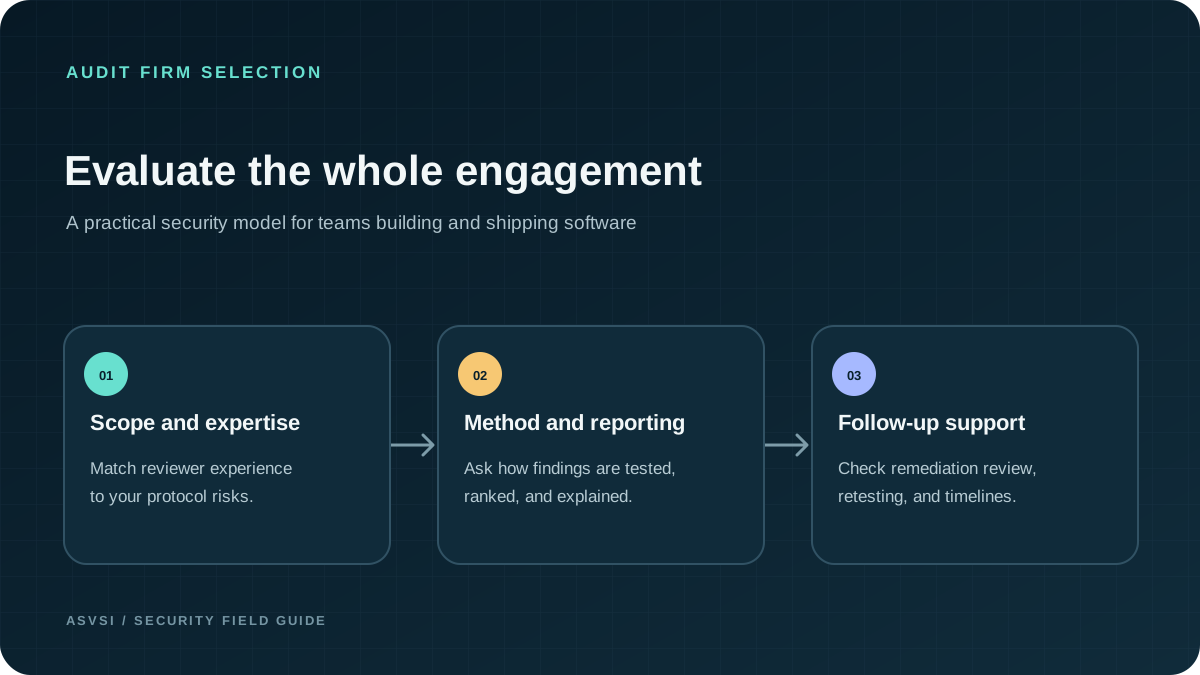
The right firm can help you catch logic issues, clarify launch readiness, and improve your confidence before deployment. The wrong firm can produce a shallow report, deliver poor remediation guidance, or create a false sense of security.
1. Who actually performs the audit?
Ask whether the work is done by senior auditors or junior reviewers. A reputable firm should be clear about the team, their experience, and how findings are reviewed.
2. Do they perform manual review beyond static analysis?
A company relying only on automated scanners is not providing the same level of assurance as one that combines automation with human reasoning.
3. Do they understand your protocol type?
A team that has deep experience in DeFi, staking, governance, bridges, or NFTs will usually be more valuable than one with generic blockchain experience.
4. What is their review process?
Ask how they approach the codebase, how they prioritize risks, and how they validate findings before finalizing the report.
5. Do they test the important edge cases?
A strong review does not stop at obvious code flaws. It considers failed calls, reentrancy paths, edge-case token behavior, permission misuse, and protocol interactions.
6. Do they review business logic, not just Solidity syntax?
Security issues are often about incentives, state transitions, and expected behavior rather than only unsafe function calls.
7. How do they classify findings?
Look for a clear severity model. High-risk, medium-risk, and informational findings should be clearly separated and prioritized.
8. What does the final report include?
A good report should explain the issue, its impact, where it appears, and how it can be fixed. Weak reports often provide vague descriptions without clear remediation steps.
9. Is there a remediation review?
Some firms only produce an initial report. A stronger partner will review fixes and confirm that the remediation actually addresses the root issue.
10. Do they offer re-audit support?
If changes are made after the report, ask whether a follow-up review is included or available.
11. What chains and environments do they support?
A company that understands your target chains, deployment model, and dependencies will usually produce a better assessment.
12. Are they familiar with your stack and tooling?
This includes Solidity versioning, testing frameworks, upgrade patterns, deployment pipelines, and any external dependencies.
13. What are the expected timeline and review scope?
Projects should be clear about the contracts in scope, the review window, and the expected number of rounds of feedback.
14. How do they handle post-audit issues?
Ask what happens if a vulnerability is found after deployment or after launch. A strong firm will be clear about the support model and escalation process.
15. How do they compare on pricing and value?
The cheapest quote is not always the best value. A lower-cost review may skip remediation support or miss protocol-level analysis. Compare the scope, process, and outcomes rather than only the headline price.
What to look for in a good partner
The strongest firms usually provide a combination of:
- experienced engineers
- clear review methodologies
- practical reporting
- an understanding of protocol risk, not just code patterns
- remediation support and follow-up validation
Red flags to avoid
Be careful if a firm:
- relies on generic checklists without context
- cannot explain how they prioritize findings
- offers vague statements like “looks fine” without evidence
- does not discuss manual review or business logic
- cannot clearly explain review scope or timeline
- has no remediation or re-audit support process
The final decision
The right audit company is the one that gives you confidence in the protocol, not just a clean-looking report. It should help your team understand risk, improve security decisions, and reduce the chance of pre-launch surprises.
A smart contract audit is a serious investment. Choose a partner who can explain what they are checking, why it matters, and how they will help you ship safely.