MCP Security: Complete Guide to Securing Model Context Protocol Servers
Model Context Protocol servers are becoming critical AI integration points, which means they require explicit security controls around authentication, tools, and trust boundaries.
MCP Security: Complete Guide to Securing Model Context Protocol Servers
Model Context Protocol (MCP) is becoming an important interface layer for AI systems. It allows AI tools, assistants, and agents to connect to external data sources, APIs, and tools in a structured way.
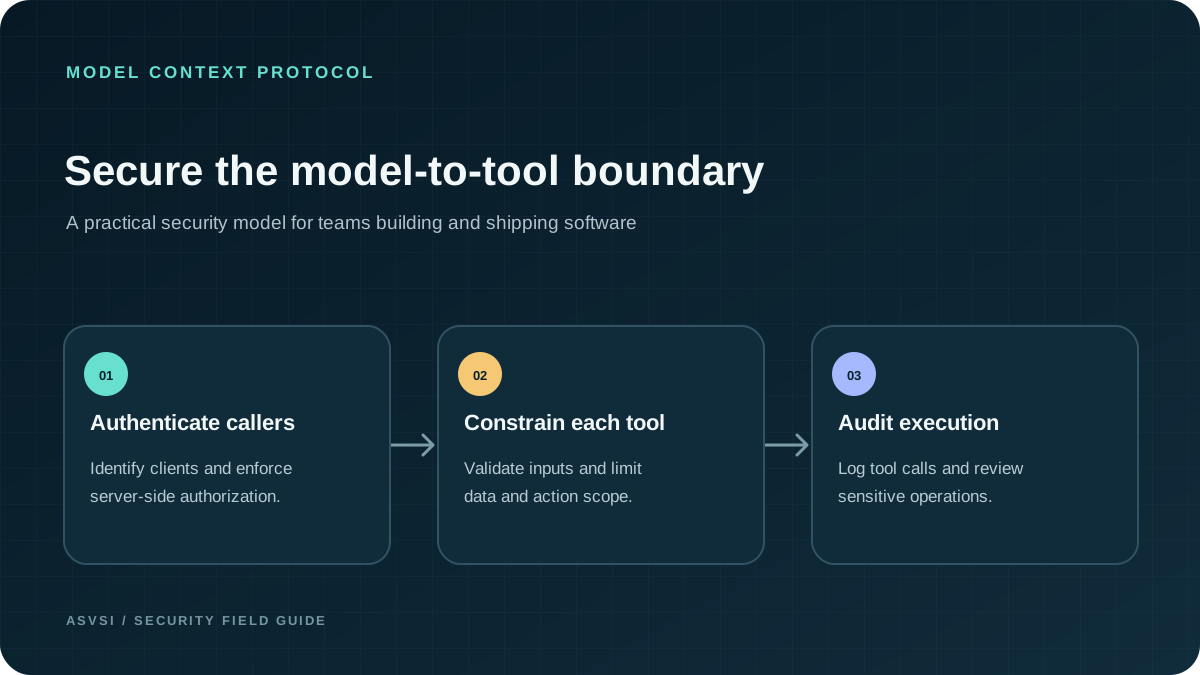
That makes MCP useful, but it also creates a new security problem: the MCP server becomes a critical connection point between the model and the external world.
If the server is improperly secured, a model may be able to access more systems than intended, trigger unsafe requests, or expose sensitive data through a trusted integration path.
Why MCP matters to security teams
MCP servers are different from a traditional API gateway or a simple backend service.
They often sit in the middle of a workflow where:
- an AI assistant requests tools or data
- a model decides which action to take
- the server exposes external capabilities to the model
- the system may call third-party APIs or internal services
That means the trust boundary is no longer just the app or the model. It is the entire tool-execution chain.
The core MCP security risks
Tool overexposure
A poorly designed MCP server may expose tools that are too broad or too permissive. If the server allows arbitrary actions without clear authorization, an attacker or a manipulated model can misuse them.
Prompt injection and model manipulation
MCP is especially sensitive to instructions that reach the model from untrusted sources. If a server passes user or external content into the model without isolation, that content can influence the agent’s behavior and steer it toward unsafe tool calls.
Authentication and authorization gaps
If the MCP server does not clearly authenticate callers and enforce scoped permissions, it may allow unauthorized access to tool functions or data sources.
Tool poisoning and malicious capabilities
An MCP server can expose many tools and resources. If a tool is malicious, misconfigured, or accepts unsafe parameters, the system may become vulnerable even when the model itself is acting normally.
Data leakage between systems
Because MCP connects models to data and tools, a weak implementation may expose internal data sources, customer information, or secrets through tool responses or logs.
Supply-chain risk
MCP servers can depend on packages, connectors, and plugins. Weak dependency hygiene or untrusted third-party integrations can create a chain of risk that is difficult to diagnose from the model layer alone.
The main MCP security design principles
1. Apply least privilege
Every MCP tool should require the minimum necessary permission. A tool should not be able to access a broad set of data sources or execute high-risk actions unless there is a clear business need and a policy boundary.
2. Validate every tool call
Tool requests should be validated for structure, authorization, and expected risk level. Do not assume that a request from the model is automatically safe or appropriate.
3. Treat model output as untrusted
The AI model is a decision engine, not a trusted security layer. Its output should be validated before any external action is executed.
4. Guard sensitive operations with approval
Write operations, financial actions, access to internal systems, or anything that changes state should not be allowed to execute automatically without explicit validation.
5. Isolate tool execution
If a tool calls an external API or internal service, the server should enforce boundaries such as network restrictions, allowlists, and data minimization.
6. Log and monitor actions
Teams need full observability: which tool was invoked, by whom, with what parameters, and what data was returned. This is critical for both incident response and security testing.
What a secure MCP server should include
A robust MCP server design should include:
- authenticated callers and service identities
- explicit authorization checks for every tool
- restricted network access and service allowlists
- input validation for tool parameters
- minimal sensitive data exposure in logs and responses
- policy-based approval for high-risk operations
- monitoring for abnormal tool usage or data access
- strong dependency and supply-chain controls
MCP security checklist
Before production, teams should review:
- Are tool permissions narrowly scoped?
- Can any tool access secrets or internal systems without review?
- Are user and service identities clearly authenticated?
- Are authorization decisions enforced at the server layer?
- Is model output validated before external execution?
- Are sensitive actions subject to approval or escalation?
- Are logs and tool traces retained and reviewable?
- Are dependencies and MCP connectors reviewed for supply-chain risk?
MCP vs API security
MCP is not a replacement for API security. It adds another layer of concern because the model is participating in tool selection and execution.
The difference is important:
- API security focuses on request validation and service boundaries
- MCP security also covers tool trust, model behavior, and the execution path chosen by the AI system
That means MCP security requires both traditional API hardening and AI-specific guardrails.
Testing MCP security before production
Teams should test for:
- prompt injection via external content
- tool abuse or unexpected parameter values
- wrong authorization boundaries
- mild privilege escalation through tool chaining
- data leakage in tool responses
- dependency and connector compromise
- unsafe tool behavior under adversarial prompts
This should be treated as a structured red-team and security review exercise rather than a simple configuration check.
Final takeaway
MCP is a powerful layer for connecting AI systems to tools and data, but it introduces a new variety of security risks that would not show up in a standard app or API review.
The right mindset is to treat MCP servers as privileged execution environments. They need authentication, least privilege, explicit approval boundaries, data minimization, and strong monitoring.
That makes MCP security one of the most practical and strategically important AI-security topics for ASVSI to own.