Wallet Integration Security: A Frontend Checklist
Reduce wallet connection risk with clear chain checks, transaction previews, safe signing flows, and resilient user feedback.
Wallet Integration Security: A Frontend Checklist
Wallet connection is only the beginning of a safe dApp experience. The frontend asks users to authorize accounts and sign transactions, so it should make the requested action understandable and handle the less tidy parts of wallet behavior deliberately.
Ask for access only when needed
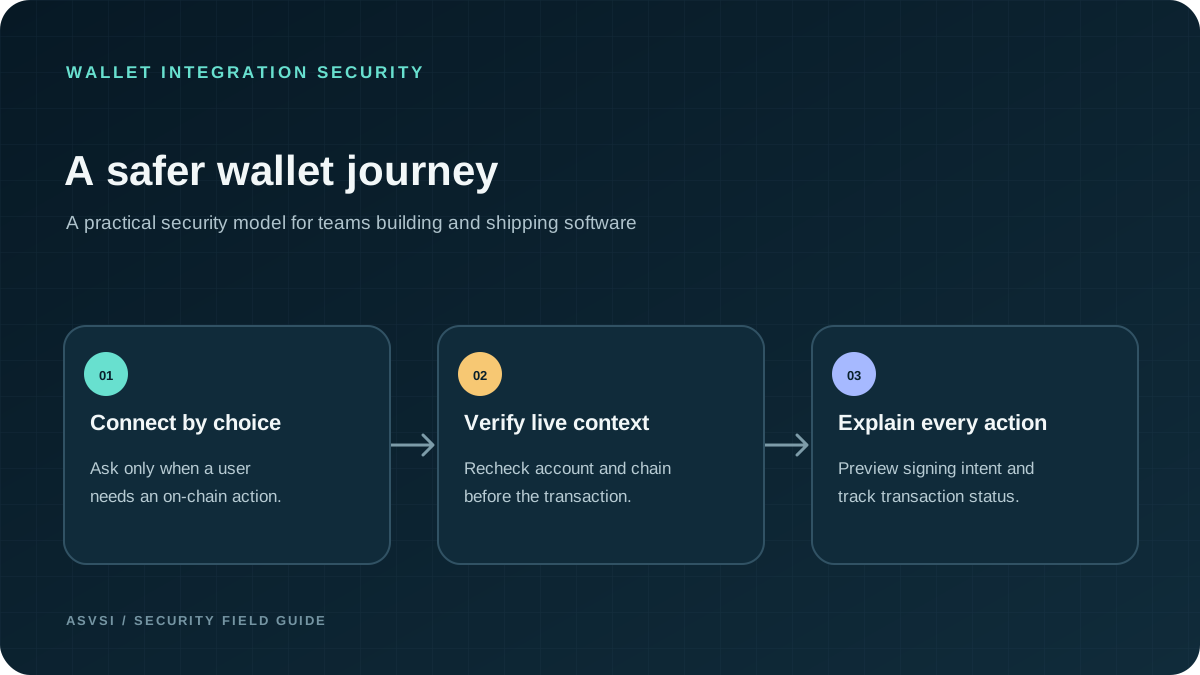
Let visitors explore public parts of an application before requesting a wallet connection. Connect in response to a clear user action, explain why the connection is needed, and avoid repeatedly prompting after a user dismisses the request.
Treat a connected address as public account information, not as proof of identity. Do not expose secrets or sensitive personal information in transaction data, logs, URLs, or client-side storage.
Check the active chain at the point of action
Show which network the application expects and detect when the wallet is connected to another chain. Re-check the chain before creating or submitting a transaction; the active account and network can change while the page remains open. Handle unsupported networks with a clear explanation and an explicit recovery action.
Never assume that a successful network-switch request means the switch completed. Wait for the provider's account and chain state to update, then revalidate the action.
Make signing requests understandable
Before asking a user to sign, show a readable summary of the operation: the asset, amount, recipient, network, and any important permissions. For approvals, explain the spender and allowance where the application can determine them. Avoid opaque signing prompts and avoid requesting broad or unlimited permissions unless they are necessary and clearly explained.
The wallet remains the final authority for signing. A frontend preview helps users understand intent, but it cannot guarantee what a contract will do; the interface should not present it as a security certification.
Handle pending, rejected, and replaced transactions
Represent the transaction lifecycle in the interface. Users should be able to distinguish a wallet prompt, a submitted transaction, a confirmed result, and a failure. A rejected signature is a normal outcome, not an application crash. Transactions can also be replaced, dropped, or reverted after submission, so avoid reporting success solely because a hash was returned.
Use the chain's confirmation and finality needs to decide when the application updates dependent state. Provide a link to a reputable block explorer for the correct chain when one is configured.
Treat provider events as live state
Wallet providers can emit account and chain changes at any time. Subscribe and clean up event handlers correctly, invalidate stale transaction state after a switch, and handle disconnects without leaving controls in a misleading state. Test the experience with rejected requests, locked wallets, missing providers, and rapid account or network changes.
Keep the integration maintainable
Use a well-supported wallet library rather than implementing provider discovery and connection flows from scratch. Keep chain configuration centralized, validate addresses and numeric inputs, and test the critical flows against the chains the product actually supports.
A careful wallet interface cannot remove smart-contract risk, but it can prevent confusing requests, stale-network mistakes, and misleading transaction states. Security depends on the contracts, the integration, and the user's ability to understand what they are approving.