Pre-Audit Review vs Full Smart Contract Audit: What Does Your Project Actually Need?
Learn when a pre-audit review is enough, when a full audit is the right choice, and how to choose the right security path for your protocol.
Pre-Audit Review vs Full Smart Contract Audit: What Does Your Project Actually Need?
Not every Web3 team needs the same level of security review at the same time. Some projects need a quick structural review before the next milestone. Others need a full external audit before launch or token handoff.
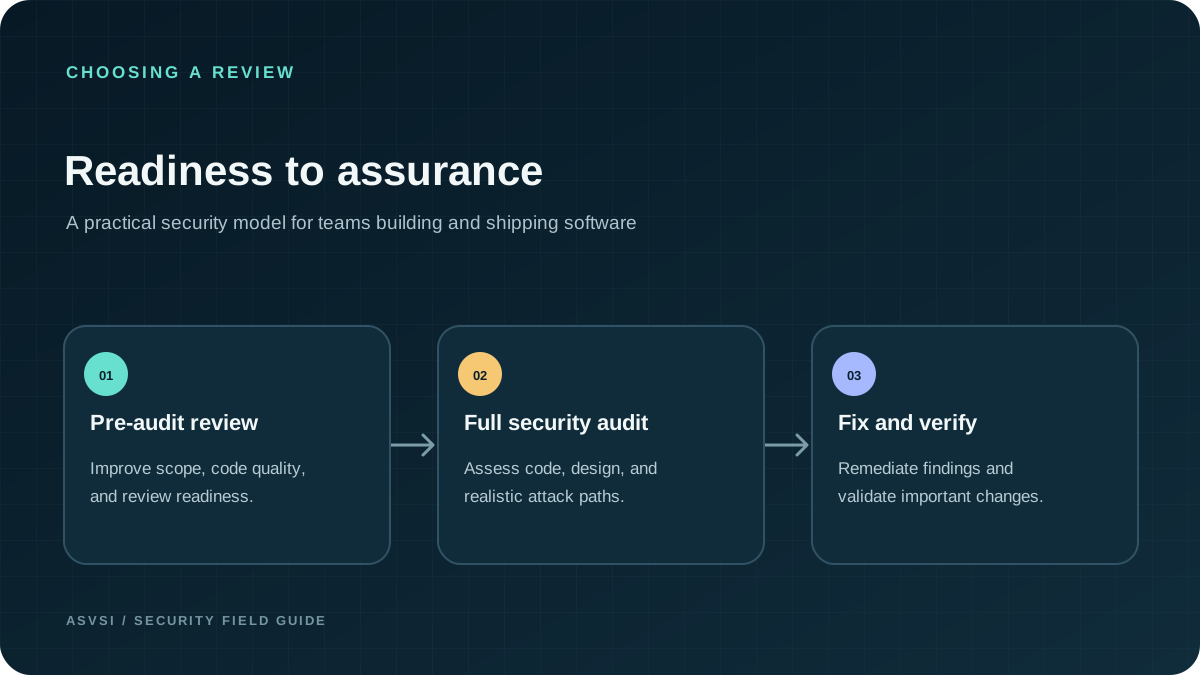
The distinction matters because the right review depends on risk, readiness, and the stage of the project.
What is a pre-audit review?
A pre-audit review is usually a focused check before a formal audit begins.
It helps answer questions like:
- Are the contracts in a reviewable state?
- Is the architecture clear enough for an auditor to understand?
- Are the critical invariants documented?
- Are dependencies and build steps reproducible?
- Are there obvious access-control or logic issues that should be fixed first?
This is not a substitute for a complete security review. It is a preparation step that improves the quality and speed of the later audit.
Pre-audit work is especially useful when a team is still iterating on architecture or trying to reduce noise before a formal external review.
What is a full smart contract audit?
A full smart contract audit is a deeper, independent assessment of the code and the system design.
It typically includes:
- source code review
- architecture review
- risk analysis
- testing validation
- vulnerability assessment
- remediation guidance
- findings prioritized by severity
The goal is not only to find obvious bugs but to assess whether the protocol is robust under realistic usage and adversarial conditions.
The real difference
The difference is not just “more work.” It is a difference in depth and purpose.
A pre-audit review is usually about readiness. A full audit is about risk reduction before launch or capital deployment.
A pre-audit can help a team:
- improve code quality
- reduce review friction
- identify major weaknesses early
- prepare documentation and test coverage
A full audit helps a team:
- get an external security opinion
- reveal protocol-level issues
- validate assumptions around economic and governance logic
- improve confidence in deployment decisions
When a pre-audit is enough
A pre-audit review may be enough when:
- the contract is still in active development
- the team is preparing for an eventual external audit
- there are obvious security issues that should be handled before formal review
- the project has a smaller scope or lower launch risk
- the team wants help on architecture and review readiness
It is a practical step for teams that want to tighten the code before the deeper and more expensive audit stage.
When you need a full audit
A full audit is the better choice when:
- the protocol is preparing for public launch
- value is being locked or transferred in production
- the contract has complex governance or upgrade logic
- the code interacts with other protocols or bridges
- the project is raising funds, onboarding users, or handling treasury assets
- the team needs an independent, formal security opinion
In these cases, the cost of a missed vulnerability can be much greater than the audit itself.
A simple decision framework
Ask these questions:
- Is the code still changing rapidly?
- Is the product in a pre-launch or high-risk phase?
- Does the protocol handle user funds, treasury assets, or critical marketplace logic?
- Are there governance or upgrade controls that need formal evaluation?
- Are you preparing to raise funding, open deposits, or launch to the public?
If the answer is “yes” to several of these, a full audit is usually the safer route.
The best approach is often both
Many teams do benefit from both services, in sequence.
- First: a pre-audit review to tighten the codebase and reduce noise
- Then: a full audit before launch or a high-value release
This helps teams avoid paying for a review of a project that is not yet in a good state while still getting the deeper assurance they need before launch.
Final thought
The choice is not between “audit” and “no audit.” It is between the right level of review for the current project stage.
A pre-audit review is a readiness check. A full audit is a launch-grade risk review.
For teams shipping financial products or user-facing smart contracts, the more mature the system becomes, the more the full audit matters. The right answer is the one that matches the protocol’s risk, complexity, and launch timeline.