Smart Contract Audit Cost in 2026: Complete Pricing Guide
Understand the factors behind smart contract audit pricing in 2026 and how project complexity, scope, and support services affect the final cost.
Smart Contract Audit Cost in 2026: Complete Pricing Guide
Smart contract audit pricing in 2026 continues to vary widely, but the market has become more mature and more risk-aware.
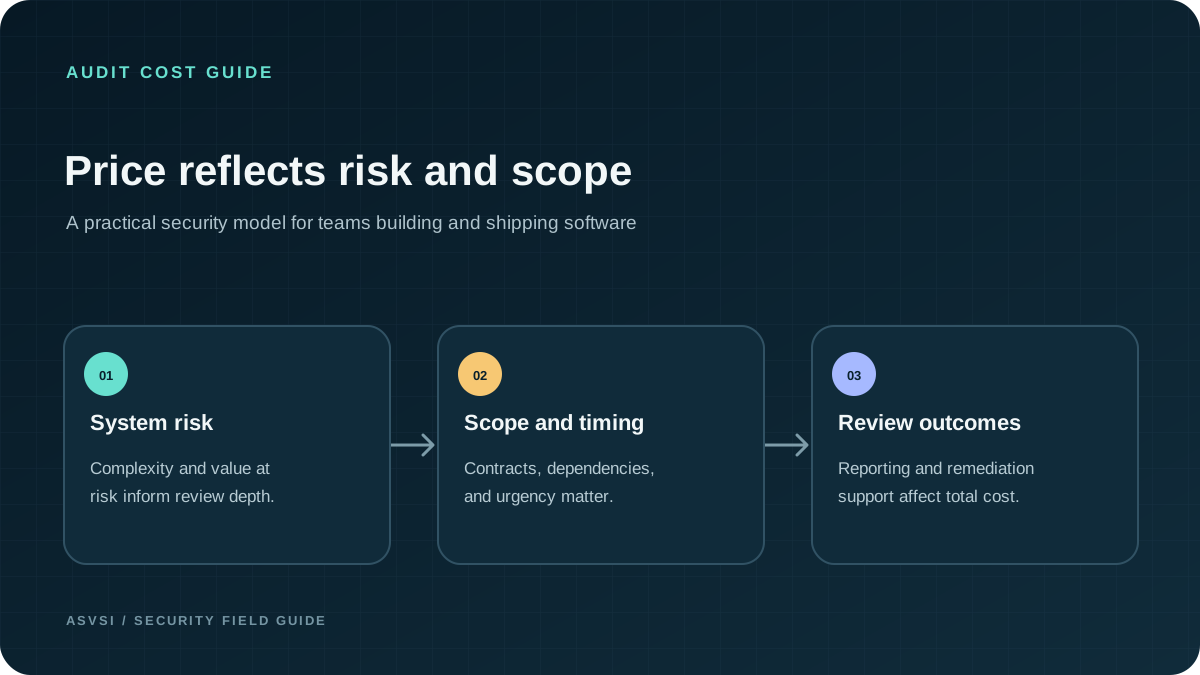
The price of an audit is not just about code size. It reflects the complexity of the protocol, the value at risk, and the depth of the review process.
What affects smart contract audit pricing?
1. Complexity of the protocol
A simple ERC-20 implementation is far less expensive to review than a complex DeFi system with staking, liquidity logic, governance, rewards, migration paths, and upgradeability.
2. Scope of the review
A review that covers one contract is much cheaper than one that reviews a full protocol, all interactions, external dependencies, and operational setup.
3. Security and reporting depth
Price can rise when the audit includes:
- broader architecture assessment
- manual business-logic review
- testing evaluation
- remediation review
- re-audit validation
4. Time sensitivity
If a project needs a review on a tight deadline, the cost may increase because the firm must allocate resources quickly.
5. Value at risk
A protocol controlling treasury funds, user deposits, or governance authority usually commands a higher fee because the risk consequence is greater.
Typical price bands in 2026
| Project type | Typical 2026 range | | --- | --- | | Simple token / NFT | $300–$5,000 | | Small application or marketplace | $2,000–$20,000 | | Staking, vaults, or reward systems | $5,000–$35,000 | | DeFi protocol / multi-contract system | $15,000–$100,000+ |
These ranges are broad because the actual cost depends on the specifics of the project and the review provider.
What is usually included
A smart contract audit often includes:
- code review
- architecture and logic assessment
- identification of vulnerabilities
- severity classification
- report and remediation guidance
- optional remediation follow-up
Some providers also include reporting for production safety, deployment checks, or post-review support.
What a cheap audit may leave out
Low-cost audits sometimes focus only on obvious issues. They may not include enough time for protocol reasoning, deep logic review, or revalidation after fixes.
That is why price should be compared with the full review scope, not just the headline number.
The right way to budget for security
Security spending should be treated as part of launch readiness, not as a final line item after the fact.
A practical approach is to budget according to:
- the value protected by the protocol
- the complexity of the system
- the urgency of the launch timeline
- the availability and maturity of internal testing
If a project handles real user funds or governance, the audit budget should reflect those realities.
Final takeaway
In 2026, smart contract audit costs remain highly variable, but the direct relationship between complexity, risk, and investigation depth is still the core pricing driver.
The most valuable audit is not necessarily the cheapest one. It is the review that gives the team enough confidence to move forward without exposing the protocol to unnecessary risk.
For Web3 teams, a well-scoped audit is often a better investment than an underpriced review that leaves critical issues unresolved.