Smart Contract Audit vs Automated Security Scan: What’s the Difference?
Understand when a smart contract audit is necessary, how automated scanners help, and why the strongest security process uses both.
Smart Contract Audit vs Automated Security Scan: What’s the Difference?
If you are shipping a blockchain product, the question is not whether security tooling is useful. It is whether you need a human-led audit or whether an automated scan is enough.
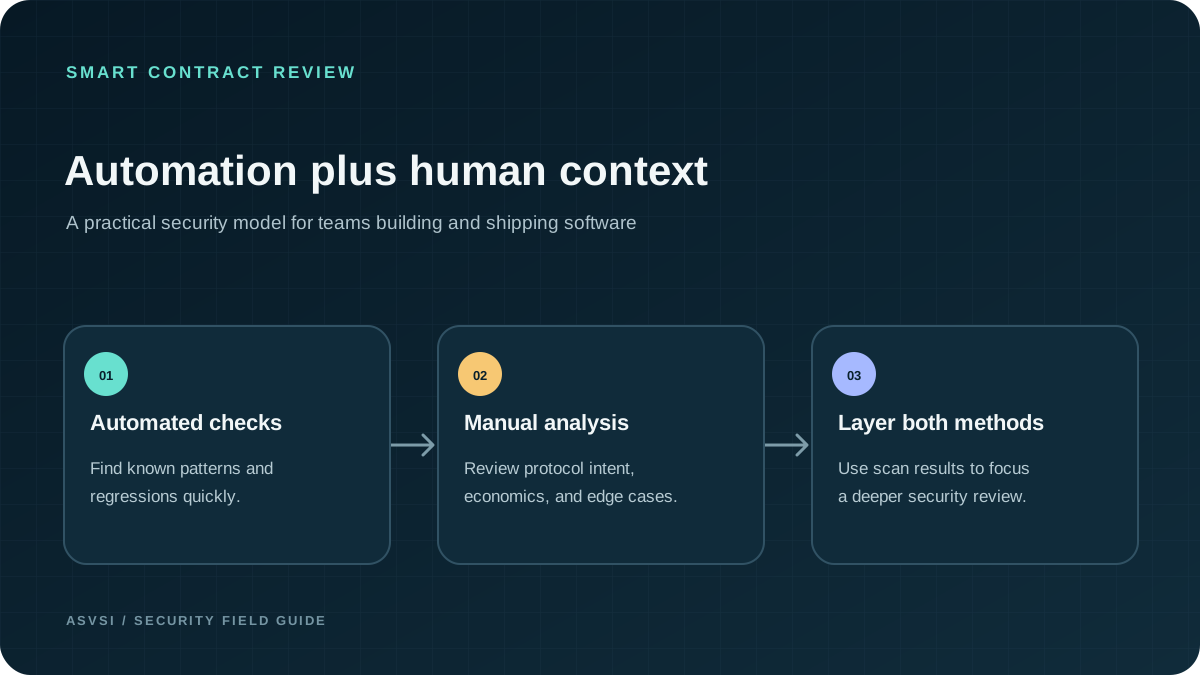
The short answer is: automated scans are a useful first layer, but they do not replace manual reasoning, protocol review, or business-logic analysis.
Why automated scans still matter
Security tools are excellent at finding patterns that are easy to miss in a large codebase. They can flag:
- reentrancy risks
- unchecked external calls
- arithmetic issues
- unsafe delegatecall patterns
- missing access control checks
- upgradeability or initializer problems
For engineering teams, this is often the fastest way to catch common Solidity mistakes before a wider review.
Popular tooling like Slither, Aderyn, and Mythril is widely used because it scales well and supports a repeatable development process. That matters for teams who want faster feedback while writing code.
What automated scanners usually miss
Automated tools are powerful, but they are not a substitute for understanding the product.
A scanner can analyze code structure and known vulnerability signatures, but it often struggles with:
- economic design flaws
- governance mistakes
- incorrect assumptions around token behavior
- edge cases in protocol interactions
- business logic that looks valid but fails under real-world usage
- time-dependent or state-dependent flows that require deeper reasoning
This is where manual review adds value.
What a smart contract audit includes
A smart contract audit is not just a static code review. It is a focused security assessment of the system as a whole.
A strong audit typically evaluates:
- contract architecture and trust assumptions
- access control and role management
- external protocol interactions
- deployment and upgrade procedures
- governance and administrative actions
- token and accounting assumptions
- edge cases, fail paths, and state transitions
- documentation quality and attack surface
An auditor often reads code with a risk mindset: not only “is this code unsafe?” but also “what could go wrong when this system is used under pressure?”
Automated scan vs manual audit
| Area | Automated Security Scan | Human-Led Audit | | --- | --- | --- | | Speed | Fast | Slower | | Cost | Lower | Higher | | Coverage of known patterns | Strong | Strong | | Business-logic assessment | Limited | Strong | | Novel attack-path analysis | Limited | Better | | Review of protocol design | Minimal | Deep | | Best used for | Early detection | Pre-launch confidence |
The real difference is not simply technical depth. It is the difference between checking for known patterns and analyzing whether the protocol behaves safely in practice.
When an automated scan is enough
An automated scan is often enough for:
- simple token contracts
- early-stage internal prototypes
- pre-production development feedback
- routine regression checks during iteration
- teams that need a fast signal before deeper review
It is a good baseline and a useful step in any engineering workflow.
When you need a manual audit
A human-led review becomes more important when the project has:
- complex token economics
- DeFi logic with cross-contract dependencies
- governance or upgrade mechanisms
- user-facing financial flows
- large sums at risk
- external integrations or bridge-related exposure
- custom logic that cannot be reduced to obvious vulnerability signatures
If the protocol handles value or user trust, the cost of missing a design flaw can be far greater than the audit fee.
Can automated tools replace an auditor?
Not really.
A tool can be an excellent layer in your security process, but it cannot replace the judgment required to reason about protocol design, incentives, and user impact.
The strongest approach is usually:
- Run static and dynamic checks
- Review code with tests and invariant checks
- Conduct a manual security review
- Remediate issues and re-verify
This layered model reduces the chance that obvious flaws and subtle protocol issues both slip through.
The practical takeaway
If you are building a smart contract product, treat automated scans and audits as complementary, not competing.
Use automation to save time and catch recurring issues early. Use a manual audit to check whether the system is actually safe under realistic use.
That is the difference between code that looks secure and code that is resilient when real value is at stake.
For teams preparing for launch, automated analysis is a useful starting point. A manual audit is the clearer signal before trust, capital, and user adoption are involved.