Smart Contract Security Best Practices for Solidity Developers
A practical security checklist for Solidity developers covering access control, logic review, testing, and safer deployment patterns.
Smart Contract Security Best Practices for Solidity Developers
Writing secure Solidity is not just about avoiding obvious coding mistakes. It is about designing contracts that behave safely under expected and unexpected usage.
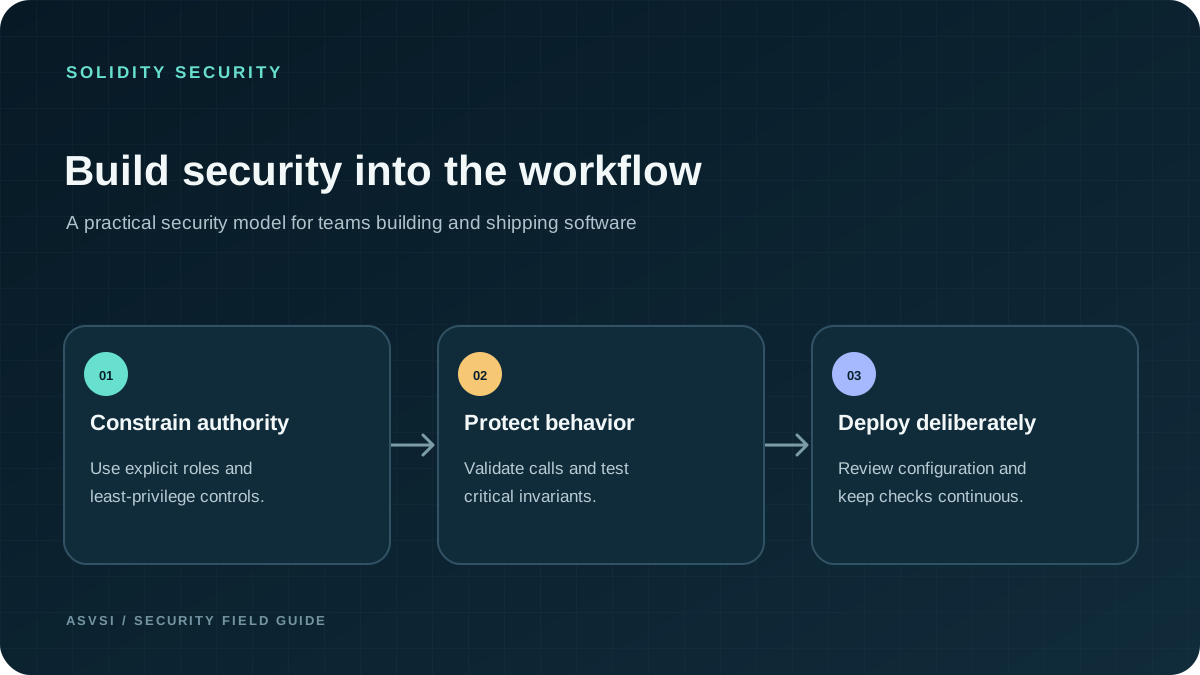
Security in Solidity begins with discipline: clear invariants, strict access control, predictable state transitions, and careful review of external interactions.
1. Keep access control explicit and reviewable
Every privileged function should clearly define who can call it and why.
Use:
- role-based permissions where appropriate
- time locks or governance gates when needed
- initializer protections
- explicit validation of ownership and admin roles
Do not leave admin privileges broad, hidden, or ambiguous. The more a contract can modify state or move funds, the more important the control path becomes.
2. Validate assumptions about external calls
Smart contracts often call other contracts or token standards. These calls may fail, revert, or behave differently than expected.
Review assumptions around:
- token transfer behavior
- reentrancy paths
- return values and error handling
- failed subcalls
- callback logic
- approval and allowance handling
The safest contracts assume hostile or unexpected behavior, not just compliant interactions.
3. Protect invariants, not just functions
A contract should preserve the rules that matter most: what must remain true before and after an action.
Examples include:
- total supply should not be altered unexpectedly
- user balances should match accounting logic
- governance actions should not bypass safeguards
- a paused or emergency state should not be bypassed by a fallback path
If a contract has business-critical invariants, test them under a variety of conditions.
4. Prefer simple logic over clever shortcuts
Complexity is often where errors live. Readability matters because it improves auditability and makes security review easier.
Avoid clever patterns when a simpler state machine or clearer flow would be safer and easier to reason about.
5. Review upgrade and initialization paths carefully
Upgradeable systems require extra discipline. Misconfigured initializer logic, unexpected reinitialization, or misassigned admin roles can introduce severe vulnerabilities.
Every upgrade path should be reviewed for:
- initializer restrictions
- role transfer behavior
- timelock enforcement
- emergency admin controls
- cross-contract assumptions
6. Use tests to prove behavior
Tests are not optional for security-sensitive contracts. They should cover:
- normal flows
- revert cases
- access failures
- edge conditions
- permission misuse
- state transitions
- large-value or boundary scenarios
Static analysis helps, but tests validate that the protocol does what the team intended in a real environment.
7. Run automated checks before launch
Use static analysis and compiler checks as part of the development loop. These tools are fast and catch common issues quickly.
However, use them as part of a broader program, not as a replacement for manual review or test-driven reasoning.
8. Treat documentation as part of the security process
A contract is easier to secure when the team documents:
- important assumptions
- role responsibilities
- upgrade procedures
- governance logic
- external dependencies
- expected invariants
If a developer cannot explain why a function is safe, it is usually a sign that the logic or assumptions need more attention.
9. Plan for safe deployment
Secure coding does not stop at implementation. Deployment matters too.
Teams should review:
- constructor arguments
- initializer parameters
- role setup and transfer timing
- verification steps
- timelock or multisig controls
- emergency or pause mechanisms
A safe deployment plan reduces the chance of a preventable operational issue after the contract is live.
10. Keep security review as a continuous habit
The best Solidity teams do not wait until launch to think about security. They consider it during design, implementation, testing, and deployment.
That means:
- review code as it is written
- validate assumptions early
- test attack paths before release
- fix issues before exposing funds or user trust
Final takeaway
Security best practices for Solidity are not a list of exotic patterns. They are fundamentals: clear authority, predictable state transitions, careful handling of external calls, strong test coverage, and an understanding of real-world protocol risk.
The strongest teams treat these decisions as part of product quality, not as a late-stage compliance step.