What Is a Smart Contract Audit? A Complete Guide for Web3 Projects
A smart contract audit is a structured review of code, logic, and security assumptions that helps teams reduce risk before launch.
What Is a Smart Contract Audit? A Complete Guide for Web3 Projects
A smart contract audit is a structured security review of blockchain code. It is designed to help a project identify logic issues, security weaknesses, and operational risks before funds, users, or governance are exposed to them.
For Web3 teams, this is often one of the most important steps before a protocol goes live.
Why smart contracts need audits
Smart contracts are hard to change once deployed. They often interact with other contracts, handle user funds, and enforce business logic in a permissionless environment.
That makes it important to review:
- who can call certain functions
- what conditions must hold for an action to proceed
- what happens during external calls or failures
- whether the contract can be upgraded or paused safely
- whether assumptions around token behavior and balances are valid
A bug in a deployed contract is not just a code issue. It can become a financial or trust problem.
What an auditor actually checks
A smart contract audit typically covers more than syntax or compiler warnings. It aims to evaluate whether the protocol behaves safely under realistic conditions.
The review can include:
- access control and role management
- external call paths and reentrancy risk
- arithmetic and accounting issues
- token transfer assumptions
- upgrade and initializer behavior
- governance and treasury controls
- business logic and incentive design
- deployment configuration and operational setup
The goal is to reduce uncertainty before a launch or major release.
Manual review vs automated analysis
A practical security process combines both.
Automated analysis
This helps spot common patterns and regressions quickly. Tools can analyze a codebase for known vulnerability signatures and highlight suspicious patterns.
Manual review
This adds the critical ability to reason through protocol logic, intended behavior, and actual risks under real-world conditions.
Automated checks are valuable, but they cannot fully replace a detailed manual review of incentives, state transitions, and contract interactions.
What kinds of issues are reviewed?
Common concerns include:
- reentrancy or logic re-entry bugs
- access-control bypasses
- incorrect accounting or rounding logic
- denial-of-service patterns
- ownership or upgrade mistakes
- assumptions about token behavior
- inconsistent state transitions
- governance or role misconfiguration
Some issues are obvious. Others are subtle and only appear when the protocol is used in a certain sequence or when multiple contracts interact.
Audit process: how it usually works
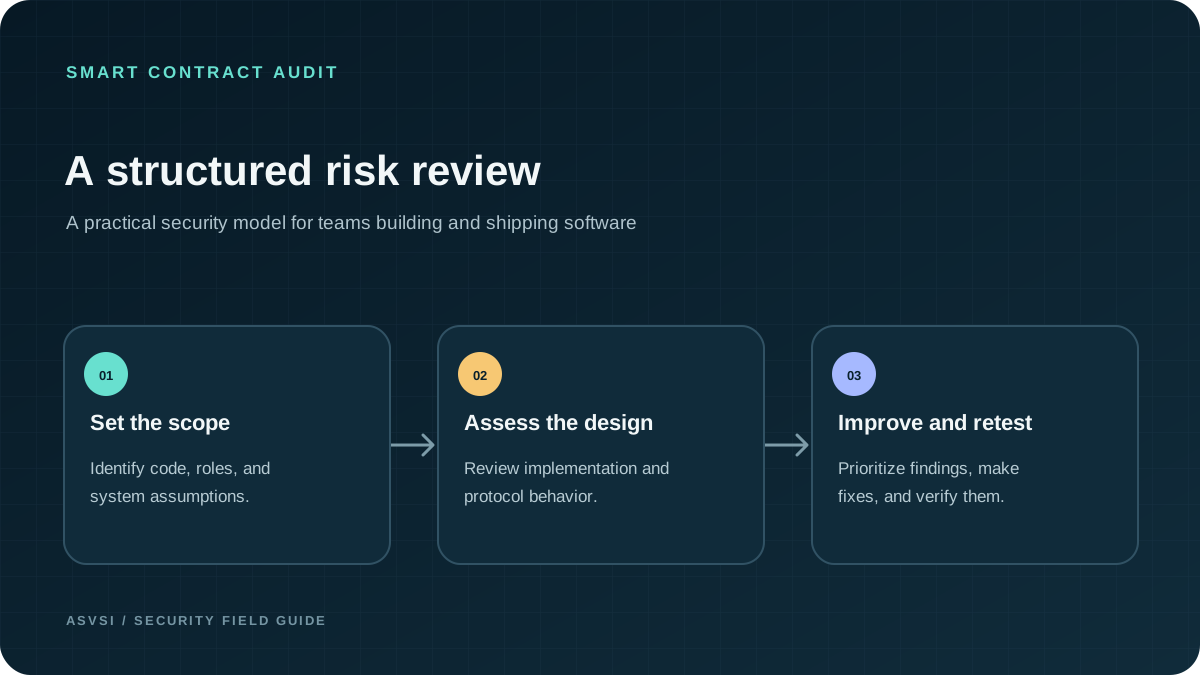
A typical audit involves several stages:
- Scope and code review
- Architecture and invariant review
- Manual code analysis
- Testing and validation
- Identification and severity ranking of findings
- Remediation guidance
- Follow-up verification after fixes
Good audits are not just “find bugs and stop.” They are also meant to help teams understand why something is risky and how to fix it.
Audit cost and timeline
Audit cost depends on:
- protocol complexity
- codebase size
- number of contracts and dependencies
- whether the review includes remediation support
- the urgency of the timeline
A small token contract may cost far less than a complex DeFi protocol with cross-chain or governance elements. Similarly, the timeline can range from days to several weeks depending on the obligation and review depth.
Pre-audit preparation matters
Audit quality improves when the team prepares well. That includes:
- documenting the intended behavior
- keeping the scope clear
- pinning compiler and dependency versions
- making builds reproducible
- running tests and static checks
- explaining privileged roles and deployment assumptions
Preparation helps reviewers focus on the actual protocol risks instead of spending time reconstructing intent.
Audit after the report
The audit report is only useful if the team acts on it.
A strong security workflow usually continues with:
- remediation of findings
- revalidation of fixes
- improved tests and coverage
- final deployment review
- ongoing monitoring or operational checks
Security is not a one-time event. It is an ongoing discipline.
Final takeaway
A smart contract audit is a structured way of asking: “What could go wrong with this protocol, and how likely is it to happen?”
It is a critical step for teams building on-chain products that handle value, governance, or user trust.
The best projects do not treat audits like a checkbox. They use them to reduce uncertainty, strengthen architecture, and launch with more confidence.